A restaurant is a business first. Susan Tung grew up a restaurant kid in her family’s Chinese restaurant, The Golden Wheel, and now owns Hanoi House in Peterborough, Ontario. Chef Waymond Wesley II, about to open his own place, asks her the questions a first-time operator should be asking. Sponsored by Save Fry Oil.
Susan grew up inside The Golden Wheel, her family’s Chinese restaurant. That is a specific kind of education. You learn the trade by absorption and you also inherit a set of habits that were never written down, which becomes a problem the moment you try to run something at a different scale.
She has since owned a Japanese restaurant and now runs Hanoi House, a Vietnamese restaurant in Peterborough, Ontario, alongside Electric City Catering.
The move from traditional family operation to modern systems-based management is the arc of this conversation. Documentation. Standardised recipes. Actual training rather than watching somebody do it.
None of that is glamorous and all of it is what makes a restaurant survive a staff change.
Culture is what happens when you’re not there.
— Susan Tung
You could have the best systems in place, dummy-proof systems, but if the people don’t care, they’re not going to follow it.
— Susan Tung
This is the correction to every operator who thinks a better checklist will fix a morale problem. It will not. The checklist is downstream of whether anyone wants to follow it.
I think empathy is just the most important thing and asking the questions of like, you know, making sure they’re taken care of and having a pay structure is probably one of the most fundamental things when it comes to restaurants.
— Susan Tung
Note what she pairs together there. Empathy and a pay structure. Caring about people and paying them predictably are the same act performed two different ways.
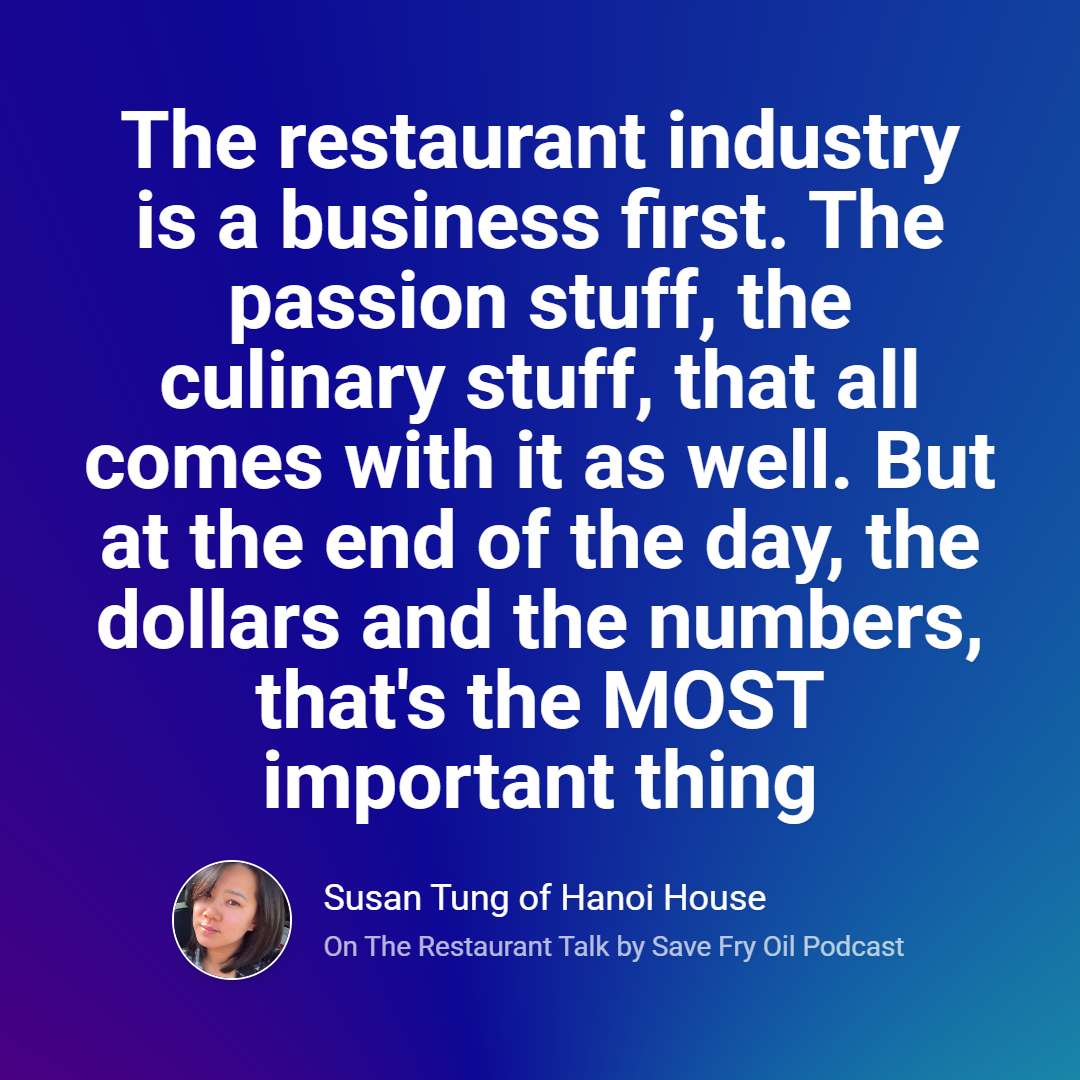
A Restaurant is a business first. The passion stuff, the culinary stuff, that all comes with it as well. But at the end of the day, the dollars and the numbers, that’s the most important thing.
— Susan Tung
Harsh and correct. Financial awareness is the thing most first-time operators postpone, and it is the thing that closes them. Chef Way is about to open in 2026, which is why he keeps returning to it.
The last part of the conversation is about balancing ownership with parenting, which is where the systems argument pays off. A business that requires you in the building every hour is not a business you own. It is a job you cannot quit.
| Entity | What it is |
|---|---|
| Susan Tung | Owner of Hanoi House and Electric City Catering, host of the Table 13 podcast |
| Chef Waymond Wesley II (Chef Way) | Host of this episode. Chef influencer, lawyer, and a first-time restaurant operator opening in 2026 |
| The Golden Wheel | Her family’s Chinese restaurant, where she grew up |
| Hanoi House | Her Vietnamese restaurant in Peterborough, Ontario |
| Frylow | The Save Fry Oil product that reduces oil absorption and improves heat transfer in commercial fryers |
| Standardised recipes | The documentation step that turns a family operation into a business |
Every link above goes somewhere different. These are the ones not already mentioned above.
Hanoi House is in Peterborough, Ontario. She also runs Electric City Catering and hosts Table 13.
Tung, Susan. Interviewed by Chef Waymond Wesley II. “Building Sustainable Restaurant Systems.” Restaurant Talk by Save Fry Oil, 2025. https://restaurant-talk-by-save-fry-oil.castos.com/episodes/chef-way-and-guest-susan-tung-share-profit-tips-and-staff-management-gold
Watermelon tuna and vegan squid made from king oyster mushrooms. Jamie Henderson is a food development chef at Wagamama, eighteen years in hospitality and...
The enemy is not the competition, it is the clock. Jim Harris has spent 25 years selling food and beverage software to the companies...
Two months from decision to open doors. Anton Kinloch opened Lone Wolf Cocktail Bar in Kingston, New York, under exactly the kind of time...